

I Almost Missed This One Line on Allergy Labels for Kids' Lunch Boxes
Allergy labels for kids' lunch boxes: the four lines a teacher needs, where to stick them on a box and a bottle, and which waterproof labels suit a school week.
The short answer An allergy label on a lunch box should say the child's name, the allergy in plain words, the action the school should take as your doctor has written it, and one phone number that answers during school hours. Put it inside the lid or on the base, where it stays readable after a term of washing. Keep it to those four lines, and check the wording with your child's doctor before it goes on.
Most parents don't think about an allergy label until the school asks for one. Then the form arrives, there's a box that says "medical information", and you're not sure how much a class teacher needs to read at 7 am, or how much a stranger at the gate should see. Here is what to put on the label, and where.
What the label has to say
Keep it to four lines. Anything longer gets skimmed by someone who is holding a lunch box, a water bottle and a child's hand at the same time.
- Name and class, so the box goes back to the right child at the end of the day.
- The allergy in plain words. "Peanuts" or "cow's milk" works. "Food allergy" does not tell a teacher what to avoid.
- The action, copied from your doctor's form. Don't write your own instructions on a label.
- One phone number that someone will pick up during school hours. A second number is fine, but make sure you check both still work.
If the school has a medical form, use the same wording on the form, on the label and on the emergency sheet in the class bag. A teacher who sees three matching lines trusts all three.
The inside of the lid is the right place
I almost missed this one. The obvious spot is the outside of the box, because that's where your eye goes when you pack it. But the outside is what gets scuffed against the other books in a school bag, and a label can rub off in the first week. Put it on the inside of the lid or on the underside of the base. The lid holds it, and the teacher sees it when the box is opened at the table.
For the water bottle, the base is safer than the side, because the side is where little hands grip and where a label takes the most wear. If the bottle has a flip lid, a small label on the inside of the lid is a good second spot.

Pick a label that can take a school week
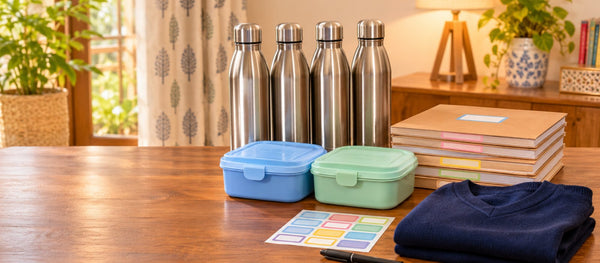
A lunch box goes into a bag, then a bus or a car, then a sink with warm water and a sponge. A label that looks fine on a notebook may not survive that routine. For a box or a bottle, our waterproof labels are the range to start with. The Kitty Cats Customized Waterproof Labels are Rs 329 and carry the name you choose.
For the small things, like the spoon, the lid clip or a second container, a sheet of small labels works better than one big one. The Rainbow Mix Transparent Labels, pack of 14, at Rs 399 give you a mix of compact, fun and mini sizes, so the allergy label can stay large and readable while the rest is sorted.
If the box goes in the dishwasher, read our dishwasher test post before you trust any label on it. Check each product page for care instructions, and don't assume one sticker suits every surface.
How to word the allergy line
Here is how we'd lay it out. This is an example of the layout, not medical advice, so swap in your child's allergy and the action your doctor has given you:
Name: Aarav, Class 2B
Allergy: Peanuts
Action: As per the doctor's form
Call: [parent number that answers in school hours]
The first two lines are for the teacher. The last two are for the person who has to act quickly. Keep the font big enough to read at arm's length, and use one colour only. Two colours make a label look busy, and busy labels get skipped.
Ask the school before you print anything
Schools handle allergy information differently. Some want a label on the box, some want it kept in the office, and some want both. Before you order, ask the class teacher where they want it. It saves a second order, and it tells you whether the school wants the allergy written in English or in the main regional language.
Bring the label to the class teacher on the first day. Show them where it sits on the box. That two-minute conversation is worth more than any amount of careful wording on the sticker.

The mistakes that come up most
- One label for everything. A combined name and allergy label gets crowded. Keep the name label and the allergy label separate.
- Marker on the base only. Ink on a plastic base can smudge after a few washes. A printed or waterproof label holds up better.
- Text that's too small. If you need to lean in to read it, the teacher won't.
- Old information. When an allergy changes, replace the label and the form on the same day. Keep the old one out of the bag.
There is one more I'd avoid. Don't put an allergy label only on the bag. Bags get hung on hooks, moved between classes and left in the corridor. The box is the thing that gets opened at lunch, so the box is where the information needs to be.
Order before the first day
Orders over Rs 399 ship free. Delivery takes 8 to 12 working days. That means you should order at least two weeks before the first day of school, especially if you are also adding a lunch box or a bottle. Our stickers and labels range and the bento tiffin boxes work well together for a first-day kit.
If the monsoon is still with you where you live, keep labels out of the bag's wet pocket and check them after the first week.


Our take
Give the allergy line the most room you can, and let the name be the smaller line. A teacher can find a child's name in a second. The allergy has to be readable in one glance.
The name tells the teacher whose box it is. The allergy line tells them what to do. The Bibliophiles team
Frequently asked questions
Should the allergy label mention the medicine?
Only if your doctor or the school has asked for it. Otherwise keep the label to the allergy, the action and a contact number, and put the medicine details on the school's medical form.
Can one label do both the name and the allergy?
You can, but a combined label is harder to read at a glance. Two separate labels, one for the name and one for the allergy, are easier for a busy teacher.
Where should the label go on a bottle?
The base is the most durable spot. A small label inside a flip lid is a useful second spot if the school asks for one.
Does the label need to be in English?
Ask the school which language the class teacher reads most easily, and write the allergy line in that language. Many families use English for the allergy and the local language for the name, so check what the school wants before you print.


Join the conversation