

Raising a Child in a Joint Family: The Good, the Hard and What Actually Helps
Raising a child in a joint family: the real benefits, where grandparents and parents clash over food, sleep, screens and discipline, what research says, and simple steps that help.
The short answer Raising a child in a joint family gives a child more people who love them, more hands for care, more languages, stories and festivals, and often more stability for working parents. The hard part is that many adults share one child and do not always agree on food, sleep, screens or discipline. Research finds both help and friction, and the difference usually comes down to how well the adults talk. Agree on a few non-negotiable rules, explain them kindly, let the rest go, and keep some time that is just yours with your child.
Picture a weekday morning in a joint family. Dadi has oiled the baby's hair, Chachi is packing three tiffins, Dadaji is reading the newspaper aloud to a four-year-old, and a parent is trying to find out whether their child actually ate breakfast or just told three different adults that they did.
That is the joy and the puzzle of raising a child in a joint family. Nobody here is doing it wrong, and every family shape, joint, nuclear or single-parent, can raise a happy, secure child. This post is about making the joint-family version work. If your home is a smaller one, our companion post on raising a child in a nuclear family looks at the same questions from the other side.
What is good about raising a child in a joint family?
A lot, honestly. The World Health Organization, UNICEF and the World Bank describe five things young children need, which they call nurturing care: good health, adequate nutrition, safety and security, responsive caregiving and opportunities for learning. They also say parents, close family members and caregivers are the people best placed to provide it. In a joint family, a child often has several of those people under one roof.
- More care and back-up. When a parent is late or unwell, someone familiar is home.
- Language and stories. Two or three languages, old songs, prayers and family stories, without anyone planning it.
- Festivals. Diwali, Eid, Onam or Pongal simply happen around the child, and the child has a role in them.
- Cousins. A built-in group to fight with, make up with and share with.
The American Academy of Pediatrics puts the grandparent role well: a grandparent who helps with care is not just "another babysitter" but the link between generations, and it encourages grandparents to share stories and read to grandchildren regularly. In many Indian homes, that is exactly what Dadaji's newspaper hour is.

What does research say about grandparents and children?
Honest summary: it depends on what grandparents actually do and how the family works together. It is not "joint family good" or "bad".
A Yale-led team screened 12,699 study abstracts and found 206 studies on how grandparents influence child health and development. Results vary a lot, and what grandparents do day to day matters more than whether they share the house.
Some findings point to real help. A study of 1,763 children in Shanghai found that children in families with fewer resources tended to benefit from living with grandparents, with teachers reporting fewer behaviour problems. Closer home, a small study from rural Vadodara, published in the Indian Journal of Pediatrics, found that where grandmothers were present, families more often practised active feeding and used anganwadi services, and the grandmother's help let mothers do more caregiving. A systematic review also found that grandmothers can influence whether a baby is exclusively breastfed, for the better when they support it themselves.
Other findings are a gentle warning. A review of grandparents feeding preschoolers found many serve large portions, encourage frequent eating and sometimes use food as a reward, alongside plenty of healthy habits. A meta-analysis linked grandparent child care with a higher risk of childhood overweight, though the authors call the evidence preliminary. Not a reason to keep grandparents out of the kitchen, just a reason to talk about the extra ghee laddoo.
Where joint families clash: food, sleep, screens and old advice
Most joint-family friction is about small daily things, repeated many times a day.
Food. "Ek aur roti" at every meal, sweets as a reward, a biscuit before dinner because the child looked sad. For many grandparents, feeding is how they show love.
Sleep and safety. The AAP reminds grandparents that times have changed: babies should sleep on their backs, there are safer over-the-counter medicines now, and grandparents should ask parents what the current advice is. It also asks grandparents to keep their own medicines up and away, out of a child's sight and reach. With several elders on daily tablets, that is easy to miss.
Screens. The TV in the main room is often on for the evening serial or the news, and the phone is the quickest way to stop a tantrum. The right age for screens, sugar and movies sums up what WHO and Indian paediatricians recommend, worth sharing with the whole family.
Discipline. A parent says no, a grandparent says "let him, he's small". Or an elder threatens a smack and the parent winces. The AAP is clear that children do best with clear and consistent rules, and that spanking, yelling and shaming are harmful and do not work.

How do you set rules when everyone is a parent?
This is the part nobody mentions. In a study of 501 Vietnamese parents whose own parents helped raise their children, the biggest factors behind conflict or cooperation were how well parents and grandparents communicated, and how controlling the grandparents were. Not money, not space. Talking. A later randomised trial found that a parenting programme with a module on the parent-grandparent relationship reduced co-parenting conflict and improved children's kind, helpful behaviour, and the effects held six months later.
Children can handle Dadi's house rules and Mumma's house rules. What confuses them is adults fighting about the rules in front of them.
Here is how we would think about it. Split every rule into two piles.
- Non-negotiable (parents decide, everyone follows): safety (medicines, balconies, water tanks, gas stove), sleep position for babies, no hitting, any medical advice from your paediatrician, and maybe one or two things you care deeply about, like no phone at meals.
- Flexible (let it go, with love): an extra story at bedtime, Nani's halwa on Sundays, a later bath, the way Chacha teaches cricket, the bhajans you did not grow up with.
Keep the first pile to five or six rules, and agree on it as a couple first. If one parent agrees with the elders in the room and complains later, the child learns that rules depend on who is watching.

Keeping your own little family inside the big one
In a big household it is easy to feel like a guest in your own child's life. That feeling is fair.
Small, protected routines help. Fifteen minutes at bedtime that belong only to the parent and child. A weekly outing for just your small family. A shelf that is only the child's. If your child is upset after school, our guide to why children cry at different ages is a good reminder to ask what happened before anyone gives advice.
Look after the elders, too. Many grandparents do hours of unpaid care every day, with their own health worries. The nurturing care framework says supporting caregiver well-being is essential, because caregivers who are supported can care better. That includes Dadi. A thank you in front of the child, a fixed afternoon rest and asking rather than instructing go a long way. For grandparents who handle school runs, our post on grandparents on pick-up duty has a few ideas.
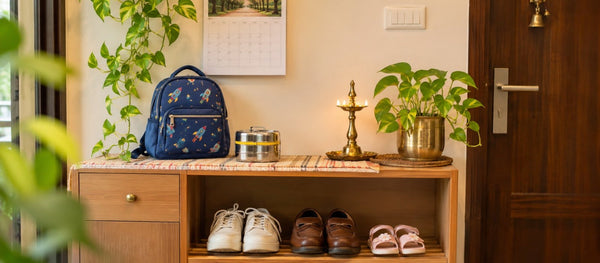
And the things that get mixed up in a big house? Almost every joint family has had the morning where three identical steel bottles stand by the door and nobody knows whose is whose. The one with a name sticker on it usually settles the argument faster than any adult can.
What you can do this week
- Write your short list. As a couple, agree on five or six non-negotiable rules, mostly about safety and health. Everything else goes in the flexible pile.
- Have one calm conversation. At a quiet time, explain the list to the grandparents and ask for their help. "Can you help us with this?" lands better than "From now on".
- Share one trusted source. On sleep, medicines or food, show what your paediatrician or a WHO or AAP page says, so it is not your word against theirs.
- Move the medicines. Walk around the house and put every elder's tablets up high and out of sight.
- Protect 15 minutes a day that belong only to you and your child.
- Say thank you out loud, in front of your child, to whoever helped with care today.
- Never argue about the child in front of the child. Disagree in private, then give one answer.
This article is general information, not medical advice. Please consult your paediatrician about your child.
Frequently asked questions
Is a joint family good for a child?
It can be very good: more caring adults, stories, languages and back-up care. Research shows both benefits and friction, and much depends on how well the adults communicate.
Is a joint family or a nuclear family better for raising children?
Neither is better for every child. Children need nurturing care (health, nutrition, safety, responsive caregiving and learning), and both family types can provide it.
What should I do when grandparents undo my rules?
Keep a short list of non-negotiable rules, mostly safety and health, agree on it as a couple and explain it calmly and privately. Let smaller things go.
How do I stop elders from overfeeding my child?
Thank them for caring, then suggest one change at a time: smaller portions with seconds if the child asks, and fruit instead of sweets as a reward.
How can parents get time alone with their child in a joint family?
Protect a small daily routine that is only yours, such as a bedtime story, plus a weekly outing for just your small family.

Join the conversation