

India's School Bag Weight Rule: Is Your Child's Bag Breaking the School Bag Policy 2020?
India's School Bag Policy 2020 caps a school bag at about 10% of body weight. The class-wise table, a two-minute home check and practical ways to lighten the bag.
You lift your child's school bag off the hook one morning and actually say "oof" out loud. Then you watch them walk to the bus, leaning forward like a tiny mountaineer. Most Indian parents have had that moment, and most of us shrug, because what can you do? Quite a lot, it turns out. India has an official rule on how heavy a school bag should be, and very few parents have read it.
The short answer India's School Bag Policy 2020, from the Ministry of Education, says a school bag should weigh no more than about 10 per cent of a child's body weight for Classes I to X. That's roughly 1.6 to 2.2 kg in Classes I and II, and no bag at all in pre-primary. It also recommends no homework up to Class II.
What is the School Bag Policy 2020?
The Policy on School Bag 2020 was published by the Department of School Education and Literacy, Ministry of Education. It came about after the Madras High Court, in a May 2018 judgment, directed the Union government to frame a policy on children's school bags. An expert group with members from NCERT, CBSE, Kendriya Vidyalaya Sangathan and several states then surveyed students, parents and school heads and wrote the recommendations, which the Times of India reported in December 2020.
It's a guideline for states and schools rather than a fine-able law, and states have adopted it in their own ways. But it gives every parent a clear, official number to point to at the next PTM.
How heavy should a school bag be for each class?
The core rule is 10 per cent of the child's body weight across Classes I to X. The policy turns that into a suggested table based on average body weights:
| Class | Average body weight (kg) | Recommended bag weight (kg) |
|---|---|---|
| Pre-primary | 10 to 16 | No bag |
| I and II | 16 to 22 | 1.6 to 2.2 |
| III to V | 17 to 25 | 1.7 to 2.5 |
| VI and VII | 20 to 30 | 2 to 3 |
| VIII | 25 to 40 | 2.5 to 4 |
| IX and X | 25 to 45 | 2.5 to 4.5 |
| XI and XII | 35 to 50 | 3.5 to 5 |
The policy itself says the table is only a guide and suggests each school build its own with staff, parents and doctors. For your own child, the simplest rule is their weight divided by ten.
For your own child, the simplest rule is their weight divided by ten.
Is my child's school bag too heavy?
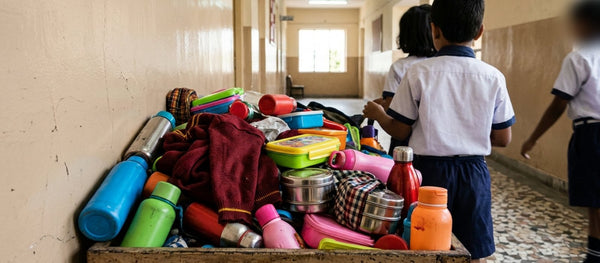
Very possibly. In the survey behind the policy, school heads said primary school bags (Classes I to V) usually weighed 2 to 3.5 kg, and two said 3 to 5 kg. From Class VI, bags went up to 3 to 6 kg. The items adding the weight were textbooks (500 grams to 3.5 kg), notebooks (200 grams to 2.5 kg), the lunch box (200 grams to 1 kg) and the water bottle (200 grams to 1 kg). The empty bag alone weighed between 150 grams and 1 kg.
Here's how to check at home in two minutes:
- Weigh your child on the bathroom scale.
- Weigh the packed bag on the same scale (or weigh yourself holding it, then subtract your own weight).
- Divide your child's weight by ten. If the bag is heavier than that number, it's over the limit.

What else does the School Bag Policy say?
Quite a lot that parents can quote:
- Weigh bags in school. Schools should check bag weight regularly and keep a digital weighing machine on the premises.
- Two padded straps, no wheels. Bags should be light, with compartments and two padded, adjustable straps worn on both shoulders. Wheeled bags are not recommended because they can hurt children on stairs.
- Drinking water at school. Schools should provide enough good quality drinking water so children don't need to carry bottles, or can carry smaller ones.
- Book weight on the cover. Publishers should print the weight of each textbook on it.
- Homework limits. No homework up to Class II, a maximum of two hours a week for Classes III to V, about an hour a day for Classes VI to VIII, and up to two hours a day after that.
- Awareness at the start of the year. A School Bag Awareness Programme for parents and students at the beginning of every session.

How can I make my child's school bag lighter?
The same survey listed good practices schools were already using: keeping notebooks and classwork copies in school, using weighing machines, and using one notebook for several subjects. At home, you can do your part:
- Pack by timetable, every night. Only today's books go in. Everything else stays on the shelf.
- Ask about keeping books at school. Many teachers are happy for workbooks or drawing books to stay in class. Raise it politely at the PTM, policy in hand.
- Choose a smaller bottle. If the school has safe drinking water, a 500 ml bottle refilled at break is lighter than a litre carried all day.
- Clear the bag on Fridays. Old circulars, broken crayons and three spare erasers add up.
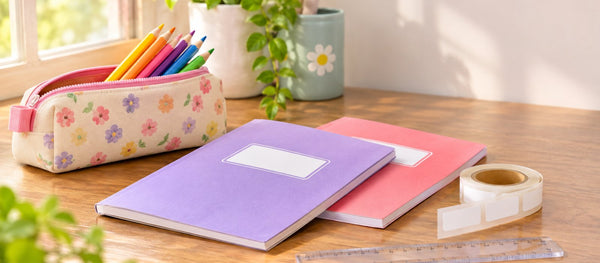
Almost missed this Books that stay in school get mixed up between children very quickly. A book name slip on every book and notebook means your child's copy comes back to them, not to the next desk.
How we can help
A lighter bag starts with a clear system, and a clear system starts with knowing whose book is whose. Our book labels are a quick name slip for every textbook and notebook, so books can stay in school safely. If you're labelling a fresh set this term, our guide to name slips for school books in 5 steps makes it a 20-minute job. And when it's time for a new bag, our school bags have two padded straps and proper compartments.


Frequently asked questions
How heavy should a child's school bag be in India?
The School Bag Policy 2020 recommends no more than about 10 per cent of the child's body weight for Classes I to X, and no bag for pre-primary children.
What is the bag weight limit for Class 1 in India?
The policy's suggested table gives 1.6 to 2.2 kg for Classes I and II, based on an average body weight of 16 to 22 kg.
Are trolley school bags allowed under the policy?
The policy says wheeled carriers should not be allowed, as they may hurt children while climbing stairs.
Is homework allowed for Class 1 and 2?
The School Bag Policy 2020 recommends no homework up to Class II and a maximum of two hours a week for Classes III to V.
Join the conversation